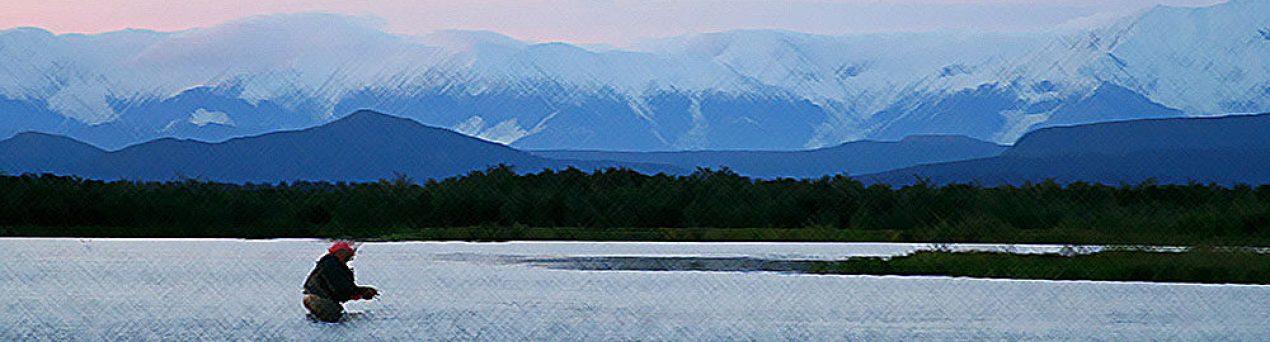

Late winter in Puget Sound is when most fly fishers eagerly begin preparing to get back on the water. Chum Salmon fry have started to leave the estuaries and move into Puget Sound, where some in a later juvenile stage spend up to one year before heading out into the Pacific Ocean.
But it is the fry in the Sound that create a feeding frenzy for the Searun Cutthroat Trout (SRC), which eat them like candy.
For most of us, chasing SRC with an appropriate fly (typically – a “Chum Baby”) begins in late February / early March.
The first thing I do, after preparing my gear and ensuring everything is ready to go, is check the tide tables.
And, unfortunately this year, the tidal cycles show the highest tides in the overnight hours with relatively high tides through the morning hours and extending well into the late afternoons.
There are two things needed for fly casting to SRC via the walk/wade approach: the first is moving water (during the tidal changes) and a beach to walk on – preferably with sufficient room for the back cast.
Two days ago, I drove down and looked at one of my favorite beaches, where there was only a thin ribbon of walkable cobble.
It’s been frustrating after the King Tides of January and February – where the same tidal conditions existed through the months (high tides through mornings); with several storms bringing winds that make most casting an exercise in futility; and a few cold spells in which getting out seemed downright unappealing.
So, I now wait for the timing of the peaks high and low tides shift to allow beach access.
Looking out through the tidal calendar, it appears it’ll be at least another 10 – 12 days before there is a sufficient shift in the cycle of the tides.
That the periods of high tides in the morning have not varied much through the last few months is somewhat unusual, but then my perspective is limited by the 12 years I’ve lived over here in Gig Harbor.
Being a fly fisher in Puget Sound means having an awareness of tides and weather.
To a lesser extent, the same is true for others using the beaches: people walking their dogs; families having picnics; or those just looking to get out and be part of nature. All those are true here – or anywhere there are beaches and tidal waters.
If one of any of them were to be stopped and asked what causes the tides, the likelihood is the answer would be a recital of a lesson learned decades ago in a science class.
The moon orbits the Earth and pulls at the Earth’s oceans, particularly creating bulges twice a month during the Full Moon and New Moon, as the alignment of the Earth, Moon, and Sun create a gravitational axis.
Most would likely recall the lesson to say the Moon moves around the Earth in a circular orbit – and that it takes a month to move around the Earth once.
Actually, the moon takes 27.3 days to move around the Earth, and while nearly circular, it does in fact have an elliptical orbit; it’s perigee to the Earth is 363,000 km with an apogee of 405,000 km.
But it’s not quite true the Moon orbits around the Earth, if it’s thought that the orbit is around the Earth’s center.
There is the existence of the barycenter.
Think of the barycenter as the center of gravity between two objects. Two objects in rotation with each other do so around the barycenter.
In the case of the Earth and Moon, the barycenter is located approximately 4,700 km from the center of the Earth (the nominal Earth radius is 6,738 km.
So, the Earth and Moon both rotate around that common center – which introduces an apparent wobble in the Earth’s orbit with the Moon.
This phenomenon begins to reveal the complex forces that drive tides, weather, and human existence on this planet.
But as the television commercials used to say – wait, there’s more.
If that same person were asked about the orbit of the Earth around the Sun, recollection of the long-ago science class would give an answer of an elliptical orbit. True, an elliptical orbit with a perihelion (closest) of 147 million km and aphelion (farthest) of 152 million km.
If asked about the other planets, a similar answer would likely be provided – given that’s the way they’re shown in most astronautical drawings.
But then there’s Jupiter.
Jupiter (due to its size) and the Sun have their own barycenter – located just outside the Sun’s surface (1.07 times the Sun’s radius). This location causes an apparent wobble in the Sun’s movement. And given the orbit of Jupiter, the barycenter is not fixed – resulting in variations in gravitational interactions of all the planets.
This interplay of complex changing gravitational forces ultimately contributes to the changes we see on our planet – including the tides and weather over very long periods of time.
That NOAA tidal predictions are quite accurate (generally within 30 minutes on near-term predictions) reflects the slowly-changing nature of the gravitational forces described. Given the complex nature of the tidal basins – from small bays to the oceans, their accuracy is even more impressive.
There are also other imperceptibly-changing but very real forces affecting the Earths’s climate and its weather, and ultimately life on Earth.
Some may have heard reports the Earth’s rotation is slowing, with reporting meant to suggest a cause for alarm. Well, there’s a cause for alarm, but it’s not based on the slowing rotation itself.
About 1.4 billion years ago, the average day was 18 hours, 41 minutes. During the end of the Mesozoic period (66 million years ago), a day was 23 hours. And a day in the Bronze Age (3,000 years ago) was only .047 seconds shorter than today.
Conversely, in recent years, the rotational speed had been increasing for reasons not well understood – leading scientists to believe they would need to delete a leap second. But climate change and the melting of the polar ice caps have apparently pushed out that need for a few years.
Think about that. Melting of the polar ice cap affects the rotational speed of the Earth. Climate change, whether anthropogenic, natural, or some combination can affect the rotation of the Earth.
Earth’s precession period (think of a spinning top) is 26,000 years. The precession causes the shifting of seasons over many millennia.
Earth’s magnetic poles are thought to flip every 200,000 to 300,000 years – based on the geologic record. But interestingly, the last reversal was 780,000 years ago. But even when they occur, it is thought a reversal takes hundreds to thousands of years.
These are have occurred outside the existence of humans on this planet. But they are all part of the past that shaped the planet we have today.
The sun itself orbits the center of the Milky Way with a cycle time of 230 million years.
Putting that timespan in terms of the Earth’s history: 230 million years ago was the late Triassic; the time of the supercontinent of Pangea – with the oceans inhabited by ichthyosaurs (shark-like reptiles up to 115 feet in length), and small reptiles on land.
Humans on this planet at this time are the inheritors of all that – and more.
Perhaps we should be humbler about our importance, and how we treat each other; the planets fauna and flora; and the Earth itself.
And if that means the tides of late winter 2025 are not what’s been seen in past years, it just means they are part of a long, long story of the life of this planet.
Waiting another week is no burden with the awareness of all that.


